Pages

Showing posts with label Musicals. Show all posts

Sunday, April 17, 2022

On Realism

     Alleluia, He is risen! Happy Easter to all! As you may have noticed, I went off of blogging for Lent, but now I'm back to the blogosphere. (Goodness, what a horrifically dull introduction... My oratory skills are going to be stunning today...)


    Anyhow, I've come back to get right to business. I'd like to discuss a rather more big-picture concept in writing: the concept of realism and depicting things realistically or fantastically in general. In short, how realistic should fiction be? What side of reality should it portray and how much? 

    Now, before we begin, I'd like to make a bit of a disclaimer. These are only my own thoughts and my own philosophy. I do not claim to have all the answers, and there have great, virtuous, admirable writers on both sides of this debate and everywhere in between. I myself enjoy and love many works on all places in the spectrum. So, going through my thoughts here, just take them with a grain of salt. 

    In the usual way of things, my mind starts clattering with ideas and long freight trains when I'm supposed to be paying attention to something else, and my most recent rabbit hole was no exception. In my music history class, the topics were first Romantic Age grand opera, and then Romantic Age realistic opera. Now, without going too deeply into either of those things, they essentially boil down to this: earlier stories in opera were about larger than life figures with somewhat fantastical, romanticized stories and great questions asked and explored, while later opera stories were about more real, relatable people with sometimes hard or decrepit lives and more direct, tangible morals to the story. If you're at all familiar with opera, good examples would be Verdi's Nabucco and Bizet's Carmen respectively. Some classic literature parallels would be Beowulf and Little Women, or The Scarlet Pimpernel and The Great Gatsby. There are many more parallels too: Oedipus Rex and Our Town; Ten Commandments and Mr. Smith Goes to Washington; Les Miserables and West Side Story; Shakespeare and Tennessee Williams; the list goes on and on. (For the sake of clarity, from here on out, when referring to the philosophy as opposed to the usual meaning of the adjective, I'll capitalize "Realistic," and, while both things I'm referring to are sort-of Romantic, I'll refer to the non-Realist style as "Romantic.")

    The idea behind the change in storytelling was simple on the surface, but I think it merits a closer look. As the theory goes, we should depict real life more closely to how it is because audiences will connect with it more and be more engaged by it. They will be more moved by it and understand it better if it relates to them closely. While it's true that depicting certain things will not be pretty, neither is real life. Suffering is such a real part of life that neglecting to depict it, or depicting it in a way that is surreal and unrelatable, makes the work difficult to read/watch/hear without skepticism. Additionally, if what's being depicted as ordinary contradicts the everyday experience of the audience, then they may dismiss the work - setting, theme, and all - as unbelievable or untrue. 

    It has been countered that some things should never be portrayed. I agree wholeheartedly, and many people who wrote in a Realistic style also did. While later modernist writers took the philosophy to a whole new level, I don't think the intention of Realism is to simply shock the audience with vulgarity, bleakness, or depravity. While it came out that way sometimes for the sake of delivering the moral of the story - as in The Great Gatsby depicting the alcoholic, abusive life of the rich class to tell us that this world and all things of it are vanity - most Realist stories are not meant to be sensationalist for the sake of it, per se. 

    That said, I believe Realist stories are deeply sensationalistic. The comment is often leveled against Romantic stories that they are larger than life and don't depict reality accurately. Now, the problem with this criticism is that Realist stories don't either. I'll come back to that in a moment. On a shallower note, we really don't want them to. Any story that depicted reality exactly as we experienced it would be dull as paint. If I started reading a novel wherein the heroine wakes up early every morning, goes to school, works, and then goes home and does homework, I would lay it away pretty quickly. 


    When consuming works of art, we want something bigger than ourselves. While it's good for us to be reminded from time to time of the flaws in our patterns and lifestyles, we become desensitized to it if we hear it all the time. If all novels in the 1920s had been oratories on the upper class's dissipation and emptiness, the message would have been thoroughly ignored. As it was, Gatsby made an astonishing effect because it was unique in its depiction. While other writers glorified the '20s glitz and leisure, F. Scott Fitzgerald tore away the glitter and beads and showed it as the lost, restless culture that it was. And that is the real point of Realist stories. The point is not as much homogeneousness as it is homily. Realist stories have to be a little harsher, a little more familiar, and a little more down-to-earth because their point is to deliver a quick, hard, simple message that people need to hear. 

    It's extremely effective whenever it's been used. Sometimes people remember the characters and the settings, and sometimes not, but they remember the bottom line of the story. I probably couldn't tell you the names of half the characters in West Side Story, but I remember vividly the visceral repugnance at the gang violence that I was meant to feel. A Realist story is like someone in a speech saying "listen up" - it catches your attention and lets you know that this last thing is really important. 

    The problem with saying "listen up" in a speech too many times is that is loses its power. It becomes monotonous and signifying of nothing. You've probably listened to a speaker before who uses the same potent phrase or comparison too many times and loses his audience's engagement as a result. Realist stories are very much like this. They serve a good purpose in a crisis, but they become desensitizing in large doses. If we take in too much of the hard, direct, and the gray - especially the morally gray - then we can come to accept it as normal and tune it out. If we're constantly fed things we're supposed to relate to, then we tend to come to see it as being indeed everyday, and thus mundane and ignorable. 

    That's a bit of a problem with writing stories in general. While we want to relate to our audience, like I said above, too much relatability creates predictability or boredom. We don't want our stories to perfectly reflect real life, and I think there is a deeper reason for that. Life in this world is never perfect - quite the opposite - and if we are only fed with the ugly, the commonplace, and the familiar, then we feel unfulfilled and lacking. We feel a distinct need for something more - some sort of resolve to our suspended existence. 

    This leads to my other problem with Realist writing. Like I said above, I think that Realist writing is quite profoundly sensationalistic. It's always an exaggeration. Realist writing is by its nature stuck in this world, and, while that may offer us a lot of wisdom on how to (or how not to) conduct our daily lives, it doesn't give us anything more universal to look to. What's more, much (not all, but much) of Realist writing is stuck in a sort-of incomplete version of this world. It's true - suffering, hardship, and immorality exist, but they are only a piece of our nature and existence. In fact, they are a small piece, like a parasite on an independent body. Poverty, sickness, and depravity are true in daily life, but so are other more beautiful, good things like marriage, children, humor, health, and simple everyday love. Most Realist stories focus on those former, uglier qualities and forget that the beautiful part of everyday life exists. And in a sense, that can be a good thing. It's hard to deliver a tough message without cutting to the quick and focusing on one thing. But nobody likes to listen to a fire-and-brimstone preacher all the time, and that's why these stories can be dulling to our senses even more than any other Realist stories. It's easy to see why we go to Realist stories more like Little Women or Mr. Smith Goes to Washington when we want something lighter - while they do focus more on this world and its issues, they're uplifting because they present us with both the ugly and the beautiful sides of life. Even if they don't pack quite as much of a gut-punch when it's needed, they are good reminders in a more regular way. 


    Now to get to the meat of the matter. I believe that a more Romantic worldview is the superior one when it comes to writing stories. While it's true that it doesn't match up to real life, as I demonstrated above, no stories really do - that's rather the point of stories. We tend to ignore things that are too familiar to us. Romantic writing also can't come to arms in a crisis the same way a hard Realist story can, but, again, hard Realist stories are best to have in crises and not as the standard. Because Realist stories are stuck in this world - whether they present its good or not - they are always incomplete and imperfect. They may be splendid works, they may be some of history's masterpieces, but they never quite reach the thing that is most beautiful in them: the transcendental. 

    In any reaching for virtue, either by criticizing its lack or by encouraging its daily practice, a work touches on something universal. In Realist works, we only get these universal values through a human lens, but we yearn for a better look at them. Everyone wants the answers to the wide, vast questions of life, and this world can't give them to us. Nothing touches the heart and inflames the mind and soul like a work that explores a great question or some transcendental good. After all, one of the transcendental goods, beauty, is the basis of all art, including writing. Without it, there would be no good writing at all. Many love to read the Gospels and the Acts of the Apostles, but most Christians I've talked to agree that the books that captivate them the most are books like Psalms, Lamentations, and Revelation: the books of mystery and of the great, universal ideas. 

    As immortal beings, we are designed to love and be drawn to the immortal. Things that mystify and go beyond our senses are what interest and benefit us most. Mysteries are not relatable; if they were, they would not be mysteries. That's precisely the beauty and the attraction of them to our nature. Fiction should reflect that truth, that ultimate Reality: that we are not alone in this immense world, and there is so much more to know than what we see and experience. Beowulf sacrificing himself to slay the dragon is Christ on the Cross; Nabucco's people exiled in a foreign land are the Church, the New Jerusalem, chosen to suffer through this world; Jean Valjean in his struggle against the world to become a truly just person is Fallen Man on his path back to God. In that sense, Romanticism is really the true realism because it depicts and hints at the Reality that is more real than anything on this earth: the Reality of goodness, truth, beauty, and of God, who is all these things and Being Itself. 
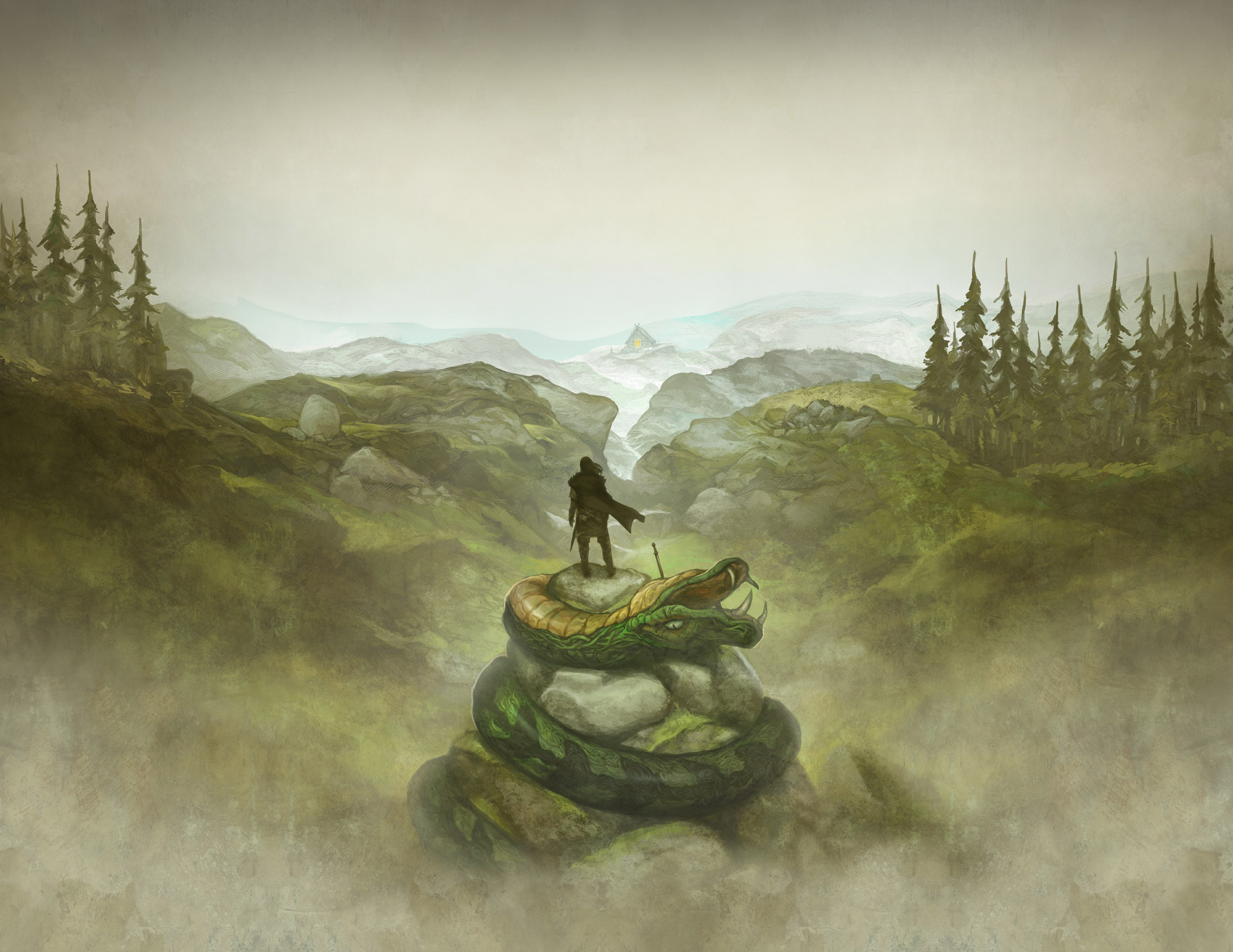

    Grand scale characters and plots exploring questions that are perennial and maybe seem obvious to us can be overdone like anything we human beings do. However, I think that they communicate the vastness of this universe and this existence much better than stories trapped on this earth do. Because Romantic works give us such a huge view to look at, they force us to actively consider and choose what our focus is. We can't passively take in a good, Romantic work; we have to internalize the ideas presented or else we can't understand it. There is no way for us to simply let it be. On that note, this can often be why many people profess not to enjoy grand, Romantic works as much. They take more intellectual effort to appreciate and cannot be taken in without engagement. Oftentimes, it's easier to have a moral handed to us without further ado, like Christ giving us parables in the Gospels. (And there's nothing wrong with that.) Remember, though, Christ also gave us Revelation. We're not meant only to be pushed towards Heaven and the transcendental goods, but also to push ourselves, to make a constant, real effort to ask the questions we must answer and pursue the goods we must acquire. For those reasons, we need the challenges in our stories to look not down at the earth, but up to the Heavens, and to ask What lies within. 

Well, that's my two cents, anyhow. What are your thoughts? Do you prefer to read more Romantic or Realistic works? Which do you prefer to write? Share your thoughts, if you have any, and, meanwhile, have a wonderful Easter season! (And give Megan some extra applause if you enjoyed this post... Some parts were inspired by an old post of hers about language in writing, but I can't find the post anywhere to link to it anymore... [EDIT: Thanks to Megan, it's now linked in the comments below.]) 

Sunday, January 23, 2022

Tradition, Progress, and Building on Seashells: Some Thoughts on Disney's Moana

[A Note: I know I am pretty behind the times in writing something about Moana, but the Muse calls when it calls, I suppose. Anyhow, this is an essay I wrote originally for school, so while I have tried to spruce it up in some regards, it still may be a little formal... Apologies on that account - hopefully it still has some interest to it, at least as a thought experiment.]


***


                 In 2016, Disney released a children’s film, Moana, detailing the story

of a Pacific Island princess and her quest to save her home. I saw it a good bit later

than that, but we'll leave that fact aside. There is one moment in the movie that

has always piqued my interest (as well as other emotions), near the end of the

movie. It's a potent little curio, and the last shot in the film: a seashell on top of a

tower of stones. But I'll get back to that in a minute.


                 In the film, the eponymous princess, Moana, is drawn to the ocean even

though her father, the king, forbids venturing beyond their island’s waters. Moana

is the crown heir of the kingdom, and she is taught many of her people’s traditions

by her parents. She, however, feels locked in by those traditions. A malignant

goddess is slowly poisoning the islands, making them fall into decay, and this

state of things is beginning to threaten even Moana’s island. Moana decides to

go against her people’s present law and search for someone who can return an

ancient artifact and restore her island’s vitality. Eventually, of course, the mission

is accomplished, Moana returns to her island and people, and she plans to tear

down the laws in favor of the ancient ways of voyaging, with everything

hunky-dory a la classic Disney style.


                   Through the film, the watcher is presented with an idea that to truly be

happy or progress as a society, we have to break down tradition and discard it.

Even though that's the movie's conscious message, however, Moana 

unconsciously undermines it. Accidentally, the film shows us how off the idea

is because it skews the definition of progress, fails to take advantage of the past,

and has no tangible goal or standard.


         Within the movie, the themes of tradition and progress are perhaps best

represented by the curio beginning when Moana’s father takes her up to the top

of the island to show her something. He shows her a stack of stones at the top of

the mountain, each one placed by a chieftain of the island upon his crowning to

“raise the island higher.” Moana is expected to place her own stone one day. At

the end of the movie, Moana returns to the island briefly and we see that she has

placed a seashell atop the stones, giving a visual symbol of her tearing down the

old ways.


         Moana is different from her people and their expectations in many ways.

She loves hearing the stories of other worlds outside her home. She has trouble

accepting the idea of being chief one day, a role destined for her from birth. She

feels called to go beyond the reef around their island, the symbol of her father’s

laws. There is something freeing in the beautiful music and wide, open aesthetic

of the scene when Moana finally makes it beyond the reef successfully. Clearly,

we as the watchers are meant to glean that freedom from tradition means

fulfillment and progress.


         The problem with this idea is that the progress Moana accomplishes

is not fulfillment, even in the scope of the movie. What we are meant to see as

the end goal – Moana transcending her people’s ways – is really only a means

to an end. Throughout the film, the ultimate evil is seen as the destruction of

Moana’s island and home, the paragon of her people’s traditions and

domesticity. Conversely, the ultimate good in the film could be seen as the

preservation of this home and people, and Moana’s safe return to her family.

The very reason Moana disobeys the laws and leaves the island is to save her

people’s way of life from destruction. If Moana’s people had merely become

voyagers at the beginning of the movie, they could have fished and sailed to 

their heart’s content, not needing the island as a home. Even at the end of the

movie, when Moana’s people do voyage, the lyrics of the ending song show an

attachment to home and the old ways: “We keep our island in our mind, and

when it’s time to find home, we know the way… We are explorers,” rather than,

say, “we are nomads” or “we are voyagers.” If the breaking of tradition and the

casting off of old ways were really the route to happiness, then why does the

happy ending of the movie merely show an addition to old traditions, rather

than their eradication?


         The key to both the intentional and unintentional portrayals of the

theme in the film is that tradition and progress are inherently related. Let's go

back to the stone tower now. Like the stones on Moana’s island, tradition is the

foundation that lets progress raise a civilization higher. With each stone, more

is added to society, but the tower would fall and break if one of the lower stones

was removed. That little seashell on the tower is such a powerful moment,

illustrating the clash of themes perfectly. The seashell does raise the island 

higher for one generation, and it looks beautiful at first, but then it makes it 

impossible for future generations to build on the tower without either discarding

or crushing the seashell. In other words, the seashell can’t remain the standard or

else no progress will be made. Tradition – the stones – must remain a part of

society’s standard in order for progress to be made. The fact of it is this: like

Moana’s people, we need to respect tradition in order to move forward in society.

While the movie wants us to see tradition as outdated and inhibitive, what it

accidentally shows us is that tradition is a healthy part of society. Even Moana’s

return to the old ways of voyaging is not a destruction of the stone tower. It makes

use of an old way of life, just altering details for the time’s needs. This is the very

definition of progress.


         In short, while the conscious theme of Moana is the harmfulness of

tradition, the movie can’t escape from the truth that tradition is necessary to

have any kind of goal or standard for civilization. The film tells us that the laws

and traditions are a handicap to fulfillment in life, but what it accidentally shows

us is that the laws and traditions are a necessary step on the path to happiness.

The "path less traveled" in the movie is, in truth, merely a branch off of the old

path. Humanity needs tradition. After all, you can’t build on seashells.


(Well, those are my thoughts, anyhow. Let me know what you think! Anything to add or contest? I offer yet another apology for the formatting... I can't seem to figure out the new way Blogger works...)


Tuesday, November 12, 2019

AABB, Part Two: Belle

Not so long ago, I posted that I would be attempting a moral defense of Disney's Beauty and the Beast; this shall be the first real chapter. And, fittingly enough, as the story begins with a prologue and then with Belle herself, so will I.

Belle is an interesting character... and a controversial one. Because there are so many interpretations of both her and her actions, she ranges from being a characterless bookworm to a self-centered feminist to a paragon of redemption. Well, here goes...


Her Treatment of Others
One of the main things people point out first about Belle is that she seems rather rude and dismissive of other people, especially in the stage version. She calls the villagers "little people," their town "dull" and "provincial," Gaston "boorish, brainless" and "monster," the Beast also "monster" and "fool," and generally has no friends. Not to mention, she seems to regard other people's lives as irrelevant - how they live is of no consequence to her. This is seen not only in her sung insults above, but also in her careless attitude towards the servants and the rules in the Beast's castle. Now, even for all this, you might notice that I still said she only seems rude and dismissive of other people. Well, the truth of it is, she doesn't want to be - this is one of Belle's defining features, in fact.

Belle certainly has a disregard for the rules, but I believe that this is more out of her contrary nature rather than her disbelief in them or a progressive mindset (as some have claimed). Think about it. She only goes to the West Wing because she was told she shouldn't; same for her eating despite his command. And, really, is there another good example of Belle breaking the rules? She doesn't do it often; I would say her breaking of the Beast's rules is more a way of being contrary to the captor she so loathes at the beginning, not a lifestyle. The involvement of the servants is merely an afterthought to Belle - she didn't do it to get them in trouble, nor did she show any sign of even recognizing that possibility.

For Gaston and the Beast's parts, Belle's critique of them is really only an offense when piled upon other things. After all, isn't Gaston boorish and brainless? Does he not treat her with the utmost arrogance and near-monstrous presumption? And does he not even go to the length of attempting to make her miserable to make himself happy, as in the case of imprisoning her father? And what of the Beast? Didn't he also imprison her father, as well as her? Did he not behave himself with every intent of being the monster he seemed? As for his being a fool, this is a mere passing shot of Belle's contrary character - it was rude and uncalled for, but it is yet another part of the arc that she shapes (as I will demonstrate below). 

As for Belle's treatment of other people in the village, her dismissiveness is a clue to her character arc. She calls them things like "provincial" and "little people" in an unintentional ironic sense of humor - she is one of them, but not enough to reap the benefits of being a little person... in that, she is the littlest of them all. In her complaining of the village life, she doesn't realize how much pettier even than them she has become - while they concern themselves with bacon, fish, bread, and the market prices, she has a leg above them and complains about life in general. But it's not meant as an insult.

When Belle complains, her intent, however pettily played out, is that she merely wants something higher than being alone in the village. Her conversation with her father reveals this perhaps more than anything. She asks him if, for her being alone, she is odd, as she hears. He replies that she should not acknowledge the other villagers - their opinions and what they say is quite irrelevant, and she should not care whether she has a friend among them. They are, after all, "the common herd," as he claims, and aren't worth much. Reluctant to accept this truth, Belle vaguely affirms the notion - if I'm not one of them yet, then it must not be worth it to be one of them, she thinks. But we never really get the idea that Belle is crazy about the idea - she accepts it because the only friend she does have says it's so.


What Does Belle Really Want?
This gets to the very root of exactly what Belle desires. She does not shun the traditional life, or other people's company - in fact, this is what she yearns for most. It is, once more, her contrary personality and the influence of her well-meaning but oversighted father that shapes her dismissal of the small world she inhabits. The best look we get of Belle's dreams are when she sings of the beauty she finds in books - not of the traveling life or of great distance from other people, but of prince Charmings and true love, of someone who will be a companion to her, and of the chivalry of old, beauteous devotion. It's not that she rejects the husband-wife-children-life attitude of the villagers, but, rather, she envies them so very greatly because that is what she desires. She doesn't want to be passed off as one more girl marrying a good-looking guy for adventure and thrills (like so many of the women fancying Gaston are), but wants desperately to marry for love, and for someone who will stick by her in life. 

Belle rejects Gaston because she knows that he will not help her. Not only is he openly unfaithful, but he cares much more about what he does outside the home than in - Belle is irrelevant to him except as someone to be there for the rare time when his whim lies with making a legacy for his household. He can't help her discover herself, he can't help her live up to a higher ideal, and he certainly cannot love her, wholeheartedly, giving instead of taking. Life with Gaston would be oh-so lonely for Belle, who already struggles so with her loneliness and stumbling journey.


Because the villagers would look well on Belle even if she married for the adventure of Gaston, Belle believes that they are errant (and, to a certain extent, they absolutely are). She herself only sees the lack of mystery and constancy in such a union, and abhors the thought. 

Even in her petty state of mind, she yearns for a true, profound relationship - one that will give her fulfillment. Belle's desire for the infinite is a desire in us all, isn't it? And even in the beginning, when it is her constant complaint against the town, the integral good of the thing remains - Belle merely wants a lasting thing.

But Does She Actually Change?
It is my belief that Belle does indeed change, and quite drastically. Think about it. In her first scene, she complains of how boring and typical her hometown is. A few scenes later, when she realizes the true tragedy that is out there, with her father being imprisoned by the Beast, she chides herself, singing "and to think I complained of that dull, provincial town!". Even though her ungrateful attitude remains at that point, we see already her change in attitudes towards the village. Then, later, when she wonders at the spell, and when she finally befriends the Beast, we hear her start to show gratitude more (as when she is healing the Beast). Then, finally, before the mob scene, she sings of how wrong she was, how stupid and silly to disregard everyone but herself, and how much, even against her own stubbornness, the Beast has changed her. And to top it all off, her farewell to the Beast as he is dying claims him a better being than herself - one more worthy of love.


By the end, really, we see a much humbler and more grateful Belle - humbled by hardship and mortification, perhaps, but humbled nonetheless. This is actually one of the biggest reasons that my preference strictly script-wise lies with the stage version (while she's ruder in the play's beginning than in the movie's, we don't get either of Belle's character arc songs, "Home" and "Change in Me," in the movie). To hold Belle's beginning character against her after her change is ridiculous, and I think it is not sufficient reason to condemn the story. 

Her ego diminishes as the story goes on, creating, actually, quite a pleasing character arc. In fact, her character arc can be seen as a reflection of the Beast's - just as he is reformed by her, so she is by him. And both have the same problem after all - egotism, stubbornness, and a rebellious temper. But by the end, both are willing to give their own ways up for the other. The story is all about redemption - after all, the only character who never reform in a story are the villains, and Beauty and the Beast is no exception. Gaston and LeFou (both of whom I'll get to later) don't change a bit, except perhaps for the worse, and same for M. D'Arque (the asylum keeper - unnamed in the movie). But Belle changes. The Beast changes. Lumiere, Cogsworth, and most of the rest change (as I'll also get to in a future post). The only people who don't change are those who represent ideal virtue in the story (Mrs. Potts) and those who represent the utmost lack of virtue (I would argue LeFou, but Gaston works as well). In a way, Beauty and the Beast is a title not just labeling the romance of Belle and Prince Adam (the Beast's oft forgotten real name, by the bye), but the two sides of Belle as well, fighting for her until the nobler one wills out. 

In this, I would defend Belle. Your thoughts on her? Do you have anything to add? To object? To suggest for future posts in this series? Please - spare a thought or two, if you have them. 

Monday, October 21, 2019

An Apologia for Beauty and the Beast, Part One: Introduction

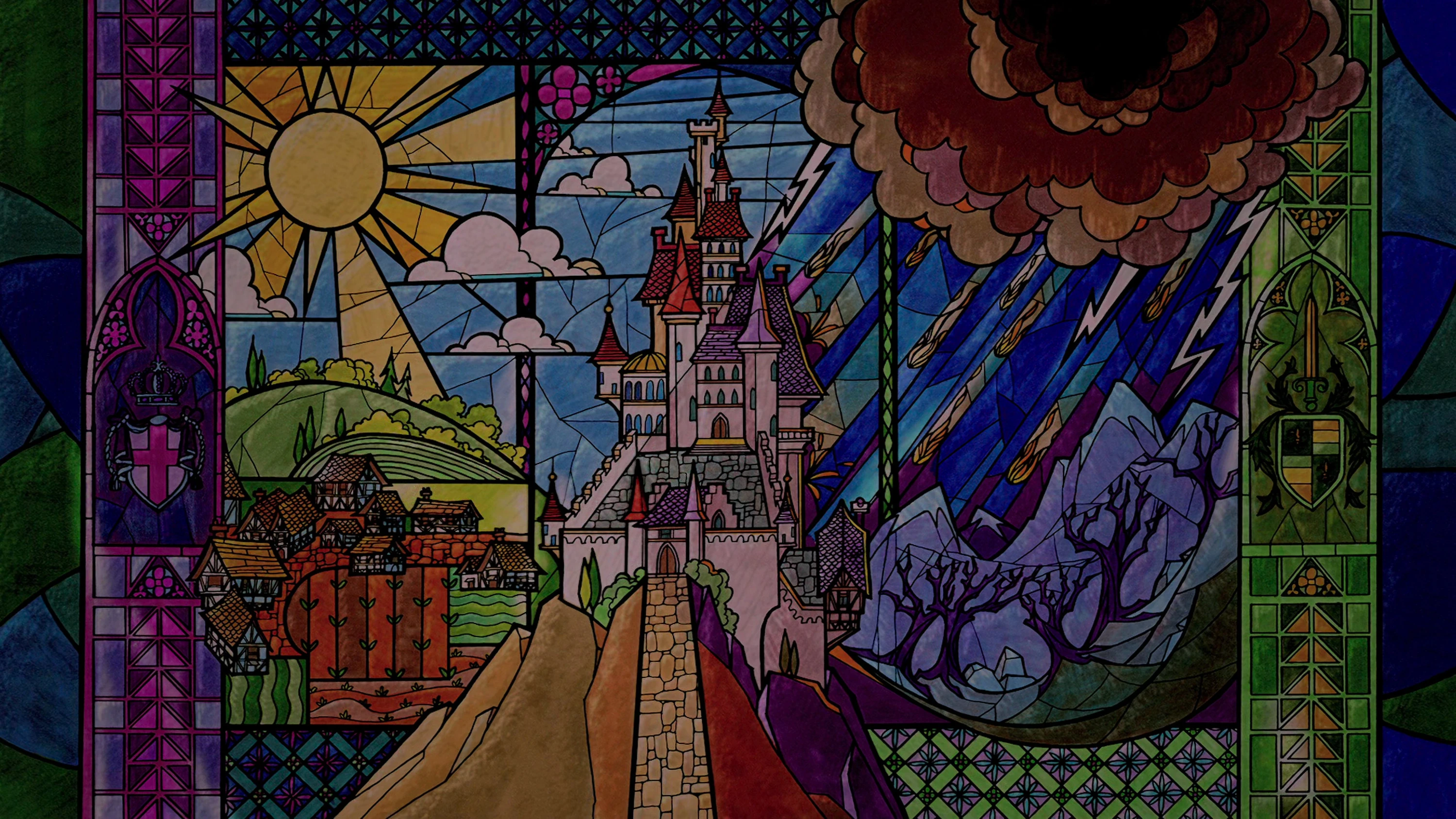
This year, I have the pleasure of being in a splendid production of Disney's Beauty and the Beast. For the rare person who has not heard of it, it's the stage adaption of the 1994(?) cartoon movie by the same name, and a musical of fair renown. It is also more than that - as a Disney movie of that company's Renaissance, it tends to skate on the edge between the commendable and the not-so-commendable Disney movies as far as virtue goes. In fact, there is rather a good bit of controversy around it. Why? Well, for lots of reasons, which I plan to expound upon.

                            Related image

Because of the play, perhaps, I've been doing a lot of thinking about Beauty and the Beast, and, of course, the thin ice that goes with it. As I was going to have to spend a lot of time with it, I supposed I would have to reason out my own thoughts on it. But, you know, there's really much more to the story than meets the eye, as I found out. And I believe it deserves a second chance. Agree? Disagree? Well, either way, I hope to provide my apologia here for the story, coming to my conclusion above through examination of the singular story, particularly from a Catholic and generally Christian perspective.
If you're a Beauty and the Beast fan (or perhaps an enemy thereof), the discussion may interest you; I hope it does. If you're not, I offer my apologies for the blog space and time taken up over the next few months on the topic. But in however many installments it takes, I'm determined to clear the name of this defamed fable, so hold tight...

Some things I hope to cover will be the character of Belle and the villagers, the traditionality/progressiveness of the story, the views on marriage and sexuality contained within, the story's morals and message, the original fairy-tale, movie and play, the artistic aspect, writing, accuracy and bias, and virtue (or lack thereof) of many of the other characters. If you hold (or have heard of) any other bones to pick with the story, just shoot 'em at me - I'll do my best to cover them. If they wreck my conclusion, all I can do, once more, is apologize for the wasted time, I suppose, but I do want to communicate this one point by my efforts: I think the story deserves a second look, and has good in it. If you disagree or, even, when all is through, disbelieve my arguments or conclusion, then that's fine, but I would like to spend some thought on a topic that's very often dismissed. Hopefully you can be patient with me while I do!

Monday, June 19, 2017

Meet The Books! - All's Fair

Hello! It's time for another Meet The Books!... finally, haha. :P Anyways, though, this one's an interesting one, because this is no ordinary novel (I mean, obviously none of my novels are, but you know what I mean). ;) This project of mine, started only two weeks exactly after the last book I introduced was, is a musical. That's right, like Broadway, dancing, singing, super funny ridiculous scenarios musical, by the name of All's Fair.
What is the genre?
Well, as I said, it's a (wanna-be) Broadway musical. However, were it an ordinary novel, it would fit into the category of Romantic Comedy.
What is the title? Time period?
The title is All's Fair, after something one of the characters says, and after that one Shakespeare quote - "All's fair in love and war". And, speaking of love and war, that brings us to the time period, which is World War II. Aren't wartime musicals the best???!!! :D Which is exactly why I wanted to write one. ;)
How is it written (Point of view, MC, etc.)?
Well, it's written in play format, but it was written in novel format first, so it does have a POV sort-of. When it was in novel format, it was in third person (limited). The main character is a rather irate American pilot named Cap. Mont Williams.
Who are the characters?
Well... :)
Mont Williams is a 22 year-old pilot who is rather easily made irritated, and can be a bit easily distracted at times. He is an American, and - just so you know - he is what I call an AF/A, in other words, an Air Force/ Army (you see, up to a certain point in WWII, the Air Force didn't even exist, but was only a part of the other two branches at that time, so Mont is currently in the Army technically, but I like to say he's in the Air Force, as that is my favored, inherited branch of the military). He has brown hair, hazel eyes, and is about six foot or so - maybe more, maybe less.
Ned Norster  is Mont's sometimes bumbling best friend. Ned is a very jokey sort, and imagines himself to be extremely well-off with the ladies, but is in reality quite laughable in his flirting attempts. He is also a pilot, and an American. He's peanut-butter-blond, and has bright blue-ish eyes. He is fit, but rather short, being only 5'9 (and believe me, he gets teased about it plenty by Mont and Irv).
Haha, this is how Ned would love to think that he is. ;)
Irv Baines is, unlike his friends, Mont and Ned, not a pilot. He is an ensign (a minor officer) in the Navy. And he rather likes to rub it in, too (because, even though his rank is technically lower than Mont and Ned's, he persists in saying that the Navy is better than the Air Force/Army). He can be rather a bit of a jerk at times, as Ned is always telling him (but I think that Ned's just jealous, because Irv actually is quite a proud proficient with the women). ;) Irv is very tall, strong of build, and fairly handsome (which he also loves to rub in), being about six foot two. He has hair that's in between black and dark brown, and has dark blue-gray eyes.
And.... yep. That's Irv all right. :P


Doctor Lucie Lavet is a French/American doctor at Mont and Ned's base who is eventually at the front. She is rather unimpressed with any of the soldiers, who - since she is one of the few women on the front - all pay plenty of attention to her. She is uninterested in romance, and uninterested in anyone seemingly, though quite willing to give a rude or sarcastic comment to any soldier who dares to try and gain her favor. She is almost as tall as Ned, being five foot seven and a half, but is very slender. She has bright red hair and silvery-blue eyes.
This could very well be Lavet and Miss No-Name, though it's unusual for Lavet to be so silly, even in a picture.
Miss Girl Without A Name is a sweet girl, who - as indicated previously - does not yet have a name. :P I'm pretty sure she's a performer for the troops, but originally she was a nurse. Truly, I can't say much about her without giving spoilers, but I can at least tell you that there's a little more to her than meets the eye. She has golden-blond hair, and has aqua-blue eyes.
And then there will be various soldiers and a couple other nurses who will appear, but none of them have set-in-stone names yet.
What does the plot consist of?
Well, hmm... How's about I show the Broadway poster I made for it to explain this? :)


The inscription reads:
All's Fair! - It's the Air Force versus the Navy in a wartime musical like you've never seen before! When two pilots meet an old naval pal on the front, the three become engaged in a hilarious three-way for a hard-to-catch Army nurse. As it goes on, the gimmicks and songs become greater and greater all in the name of the rivalry's slogan - "All's fair in love and war"!
So, perhaps you can figure out what the plot is just from that purposefully over-dramatized summary, but if not, I'll lay it out. So, due to a certain chain of events, Irv, Ned, and (due to the other two's cajoling) Mont challenge each other to try and gain the impossible Dr. Lavet's favor in a certain amount of time. Because it is for a friendly bet, none of them is afraid to use any amount of gimmick or trick to get ahead of the other, resulting in quite a comedy. However, bind this plot in with Mont and Ned's immense wish to help on the front, and then the war hitting them, and all that going on, and then the nameless girl's whole sub-plot, and this is what All's Fair consists of.
What is the setting?
Why, WWII, of course! It starts out in a random base in Haiti, but then *spoilers* Mont and Ned's wish of going to the front is fulfilled *spoilers end* and it takes place on the front in Italy from there.
Don't ask about the quote... it is indeed fitting for a certain character in the story, but I won't say who... :)
Who are the favorite characters in it?
So far, everybody (meaning the only two readers I have for it and myself) has favored Ned. He has risen rather to levels that he was not meant to go to in people's favor. So much so, that I may or may not kill him off. Just kidding.... maybe. ;)
What is the favorite scene?
Um, so far there's only one written scene that's really been noted above the others. A scene in which Mont converses rather briefly and irately with Lavet, and ends by running off (because he was late for something very important, due to Ned, which was also why he was irritated).
Any themes of music for this work?
Well, originally, back when it was just a novel, it was inspired by the old song I Left My Hat In Haiti, from the movie Royal Wedding. And I had also considered as a romantic theme once the song I Won't Dance by Frank Sinatra. However, now, it has the songs I have written for it. I would put a pic of the music, but I am a bit paranoid about random people finding it and taking it. :P The songs I've written for it so far are (the temporarily-named) A Piece Of Advice, sung by Irv, and contributed to a little by Ned; Even Now, a duet between Mont and Lavet; The Almost Bride, another Irv song, but this one a solo, and then a vague idea for one of Ned's songs, which I have also temporarily named I Guess So.
Any drawings?
Besides that Broadway poster, only one unfinished one of Irv and a girl (whom I will not name in case there are spoiler-seeking readers in the crowd). I will not share it, only because the girl's looks are very much a giveaway to the keen reader, not to mention the pose that the two are depicted in.
Strong point in story?
Probably the characters. I feel like - especially in writing songs for them - their voices are coming through very well, especially Irv.
Weak point in story?
Well, probably the slow beginning. I mean, if it were a normal novel, nobody among modern readers would really probably take a second look, because the beginning is fairly quiet and very much non action-packed.
What are you plans for it?
Well, to finish composing the music, finish putting it into play form, and then give it to the world! I know it's rather ambitious, but I want to try and actually get it out there and performed. I know... in my dreams... :P :)
Any particular writing habits for it?
Well, when I'm writing the music, I always sit and do it at my piano, and I generally take a pretty long time tweaking it. When I'm writing the actual story, I often listen to Oldies music (particularly songs from old movies), and also like to eat mini-pretzels while doing so.
If it were made into a movie, what would be your ideal cast for it?
Well, I'm sure I do envision it as a movie someday, and is definitely intended to be performed in some manner or other. I think I would take Gene Kelly as Mont Williams, just with brown hair instead of black. And for Ned, I can see either Santino Fontana or Nelson Eddy playing him, though I suppose a young Frank Sinatra would also act the part well. And Irv, I can see being played by a dark-haired Howard Keel (though Thomas Hampson playing him would be most amusing indeed). I would have Esther Williams as Dr. Lavet, and either Laura Osnes or a blond Katherine Grayson as the nameless sweet girl.
Anyways, though, that's about all there is for the story of All's Fair. Now to go and write more songs for it! :D
What did you think? Would you read it? Would you go and see it if it were being performed? Is anyone a little nervous about Belle attempting to be a composer? Was anybody not bored out of their skull reading this? ;)


Saturday, January 21, 2017

Ten Musicals I've Never Seen In My Life (But Still Love The Music Of!)

Hallo! Today, I decided to try something 'new', and be random. ;) You see, I am huge on the performing arts. I love music. I love opera, I love ballet, and I love Shakespeare, but probably most of all, I love musical theater repertoire. I was going in my head through all the musicals I liked earlier, just to count, and I realized a good number of them I loved, I had never seen performed in my life. Hmm... Could there be something behind this? Who knows? But, I suppose I'll list this marvelous bunch of theatre musicals which I have never witnessed, but still obsess over.


Fiddler On The Roof
So, I am still not quite sure how I've never seen either movie or production of this thing up to now. My mom is totally obsessed with it, and has seen it both professionally performed and seen the movie of it. She even had a t-shirt of it when she was in high-school. So, why haven't I seen it? *shrugs* You tell me. But, I love the music so much! I like the song "Tradition", and am constantly getting "Sunrise, Sunset" stuck in my head. Not to mention, I have listened to/tried to sing "If I Were A Rich Man" countless times. I love the idea of Tevye's (is that how you spell it?) character, and the plot sounds good. And yet, I've never seen it. Oh well... A friend of mine will be in a play of it in the summer, so hopefully I will finally see it then.


Singing In The Rain


Ach, I wanna see this one soooooooo badly!!! Especially now that I'm beginning to love Gene Kelly movies. He's just so little-boyish and cute, and it's just adorable to see him make that little grin like a kid being taken to the playground. And then I am quite a fan of the songs "Good Morning", and "Make 'Em Laugh", and quite an immense fan at that. And then, the only scenes I've ever seen of it, for the most part, I loved. I love the actual "Singing In The Rain" scene so much, and the whole thing is so cute I might just have to take a few pointers from it for my Romantic Comedy, The Top-Hat Gang. In fact, I might have to invent a time machine to go back in time and grab Gene Kelly to be in the movie production of The Top-Hat Gang, if it ever happens. :) Next time I'm at the library, I'm definitely planning on taking home this one.


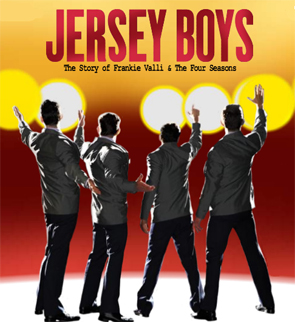
 Jersey Boys


Okay, so there's actually a reason with this one why I don't see it. There are certain aspects about the plot that may or may not be a bit off. I couldn't be sure, so I left it alone aside form the music. However, the music is mostly just redos of the original Four Seasons music, so I absolutely loved it! So, even though I won't watch until I can be sure about the plot, I will continue to listen over and over to "Sherry" and "Walk Like A Man".

South Pacific


This is another case of choosing not to see it as of yet. Because, unlike the simple uncertainty of Jersey Boys, I actually know for a fact that there are some rather distasteful things concerning the background plot of this story. Not the best Rodgers and Hammerstein there is. However, while I may wait a while to watch it, I am completely happy at the moment listening to my two favorite songs from it - "Some Enchanted Evening", and "Younger Than Springtime".


Newsies

Okay, this one is kind-of a cheat. I saw the movie version (which I loved!), but I have never seen the Broadway version. In fact, I've never seen it performed at all. Just the movie (which was still brilliant!). I have rare seen a movie with so many frustratingly catchy songs in it. For the movie version, there was "High Time, Hard Times", "King Of New York", and "Seize The Day". For the Broadway or movie, there was "Santa Fe", "The World Will Know", and "Carrying The Banner". For specifically the Broadway, there was "Something To Believe In" and "For Once And For All". It was sooooo awesome! Some friends went to go and see it premiere with the Broadway traveling cast, and they loved it... I want to see it so bad! :D Oh well... Back to listening to "The World Will Know" (my personal favorite from it) for the twentieth time...


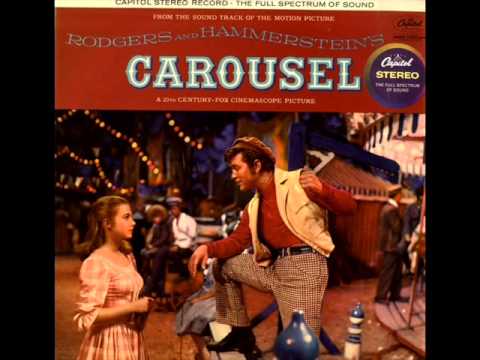
Carousel


This was one I had the chance to see, but didn't because I knew it was depressing. I already knew the way the plot went, and was utterly depressed just thinking about watching it. I might muster up the courage to watch it someday, but until that day, I guess I will have to 'walk alone'. ;) My favorite songs from this one are "You'll Never Walk Alone", and "If I Loved You" (which is a duet, most beautifully sung in the cover by Josh Groban and Audra McDonald, btw. I almost liked that duet as much as "Anything You Can Do" from Annie Get Your Gun. Almost, that is). ;)


Les Miserables
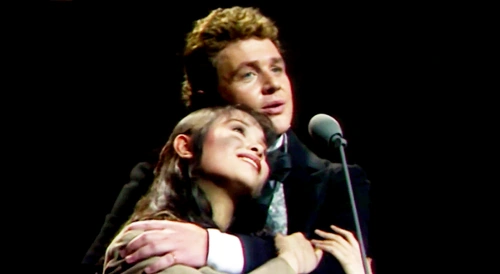
Yes, I know. Marius and Eponine. Unfortunately it was the only really, truly good, picture I could find of my favorite cast.
This is probably the biggest one of all. I seriously obsess over the music in this one, but have never seen one second of movie or performance. I read the book, but, while it was very good to a certain extent, I personally found it very frustrating (so would anyone who loves Jean Valjean and reads it!). Besides the fact that Marius isn't as cool in the books. Okay, my thing about the not having seen even a second of it isn't totally true. I know some of the scenes in which the songs are, and have seen the actual full scenes of "Do You Hear The People Sing", and "A Heart Full Of Love", and various clips of my favorite cast, the one with Lea Salonga and Michael Ball in it. I love soooooo many songs from this! I like "Look Down" when it's done right, I love "The Trial", and the "Epilogue", I like "Stars", I absolutely love "Empty Chairs At Empty Tables", and I like "One Day More". However, my favorite song above all of them is also the one that I cannot stand any of the casts singing anymore. My favorite song in Les Mis is "Bring Him Home", one of the most beautiful, meaningful songs that was ever put into theatre, in my own opinion. However, like I said, I can't stand any Jean Valjean singing it anymore. Why? Because of this. A link to David Miller singing "Bring Him Home". David Miller, the American tenor member of Il Divo sang it so angelically, I felt as though it was really an angel in his form. I do warn you about listening to it, though. If you do, there will never be another version of "Bring Him Home". Never was anybody so God-blessed in skill and beauty of voice as was David Miller. And he definitely raises that gift back up when he sings this song. So beautiful...


Kiss Me Kate


I actually don't even know a whole lot of the numerous songs from this one. I have only heard  select few, but I loved each one of them. I have heard "Wunderbar" and "Brush Up Your Shakespeare" most prominently among them. The first one was a brilliant, operatic duet between the singing couple of all musicals, Katherine Grayson (an insane soprano) and Howard Keel (remember Seven Brides For Seven Brothers?). "Wunderbar" was a splendiferous, German-cultured duet (I say German-cultured because it was very German-sounding, but it was actually sung in English except for the word "Wunderbar"). As for the second song.... *laughs* Well, I have rare heard such an amusing song that had to do with Shakespeare. Most of the Shakespeare I have had experience with was more to the dramatic and sad side, so I laughed and laughed when I heard this surprisingly amusing song. While I have never seen this show, I do hope to hear "Brush Up Your Shakespeare" again sometime soon. Not to mention the deliciously hilarious-sounding plot (which does not consist of any love triangles - don't be fooled by the above picture!), that plot being partially based off of "The Taming Of The Shrew". Maybe, just so I can see it and understand the play the characters in it are putting on  (which is The Taming Of The Shrew itself), I'll brush up my Shakespeare. ;)


Camelot
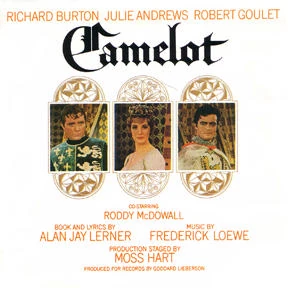
Oh, I love the music from this! I even have the original cast soundtrack to prove my obsession. :D Especially "Camelot" and "If Ever I Would Leave You". Although, I also love the hilarity of "You May Take Me To The Fair", "What Do The Simple Folk Do?", and "I Wonder What The King Is Doing Tonight". And "How To Handle A Woman" is also funny after a fashion, but very sad if you think of it in the light of the story. "C'est Moi" is pure frustrating laughter if you think of who the person singing it is (that being the arrogant and very flawed Lancelot himself). My only regret for never having seen this one, and not trying to, is that I can never see the only cast I would have ever wanted to see. I can never see Richard Burton as King Arthur, or Robert Goulet as the despicable but amazing-voiced Lancelot. I even somewhat regret never seeing Roddy McDowall (Mr. Creeps himself!) as Sir Mordred. I shall, however, never stop singing "Camelot" about the house, or being sad of the ending of that play which I've never seen.


Phantom Of The Opera


I never saw this because I have heard some rather unsavory things about scenes in the movie. And some rather disturbing things about the terrible quality of the singers in it. And obviously I don't see the Broadway traveling cast of it come my way every single day, so I have not yet had the chance to see it. But, I love songs "The Phantom Of The Opera", "Think Of Me", and "All I ask Of You" from it. And while I don't particularly like the lyrics to any of them, "Prima Donna", "Music Of The Night", and "Masquerade" get seriously stuck in my head. (Psst! The best version of "The Phantom Of The Opera" is by Sarah Brightman and Antonio Banderas!) I liked the story well enough when I read the book, but it was a little weird. And I am rather ashamed to say that, putting aside his rather edgy morals, which I decidedly do NOT support, I was always on the Phantom's side... :P I do not like Raoul! I guess that wraps it up. It's uncanny how many musicals I like that I have never even seen. I really want to see some of them. Then there are some others that are better left alone for the moment, at least. But, whether I am ever going to see them, or whether I plan on steering clear, I'll keep on listening to the beautiful music of these ten musicals.


What say you on the matter? Have you seen any of these? Do you like the music? Are you sighing over the fact that some of the best casts in these are no longer performing? Perhaps are you agreeing on my resolutions to watch some and not watch others? Maybe one of these is a beloved musical to you? Maybe you could give me recommendation for one...? Is any other blogger having these formatting problems with the spacing on posts?!